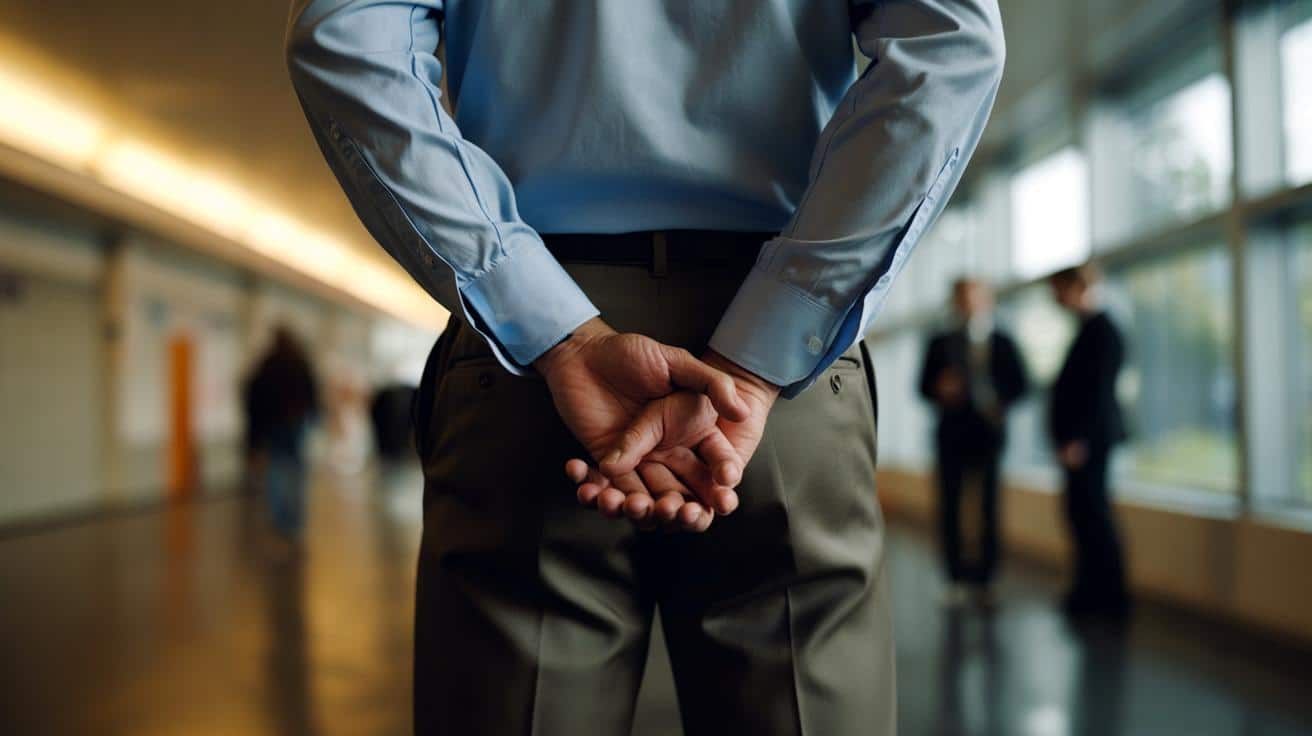
You notice it at meetings, in waiting rooms, in long supermarket lines. That one person who stands perfectly still, hands clasped behind their back, gaze drifting somewhere far away. They look calm. Or are they hiding something? You catch yourself doing it too, in front of your boss, your partner, a stranger who makes you a little uneasy. This simple gesture feels natural, almost automatic. Yet the body rarely does anything by accident.
Psychologists and body language experts have been watching this posture for decades. Power, fear, control, submission – all of that can be quietly folded into those hands you tuck away behind you.
Your hands behind your back are talking, even when your mouth is not.
When your hands behind your back scream “I’m in control”
Watch a headteacher walking down a school corridor. Or a police officer inspecting a scene. Or a CEO pacing in front of a window before a big meeting. The same silhouette appears again and again: straight back, slow stride, hands calmly locked behind. This is classic dominance posture, the pose of someone who feels they own the space they’re standing in.
The chest is open, vital organs exposed, no arms shielding anything. That’s the silent message: “I’m safe here. No need to protect myself.” It’s not always conscious. The body simply broadcasts the level of inner confidence like a radio signal.
Picture an older surgeon walking down the hospital corridor after thirty years in the same department. He moves slowly, sleeves rolled up, hands folded behind his back. Nurses step aside, patients glance at him, nobody questions his path. He doesn’t swing his arms or fidget with his phone. His whole body is saying: I know exactly who I am here.
Now imagine a child copying that same walk, mimicking an adult they admire. They clasp their hands behind them as they cross the playground. It looks a bit theatrical, but the intention is the same. They’re trying on authority like a costume, testing how power feels in their own skin.
Body language isn’t just reflection; it’s rehearsal.
From a psychological angle, this posture sends a clear signal of *self‑possession*. By removing your hands from the “front stage” of your body, you’re refusing to use them as shields or tools of persuasion. You’re not pointing, not gesturing wildly, not begging for attention. You’re saying: “I don’t have to fight for this space, I already have it.”
Research on nonverbal dominance often finds that expansive postures – open chest, lifted chin, weight evenly distributed – are read as higher status. Hands behind the back naturally widen the upper body and slow movements. That calm slowness is often read as power, because anxious people tend to move fast. The body knows the script, long before the brain starts writing lines.
➡️ Psychologists note that people who walk the same route daily process uncertainty differently
➡️ Many households waste money by using appliances at the wrong time of day
➡️ Psychology explains why emotional restraint often develops quietly, without people even noticing it
When your hands behind your back hide your nerves
The same gesture that screams authority in one context can whisper insecurity in another. Think of someone at a job interview, standing in the reception area, hands behind their back, rocking slightly on their heels. They’re not surveying their kingdom; they’re trying to keep their fingers from trembling. For many people, locking their hands out of sight is a quiet emergency solution: if others can’t see what your hands are doing, maybe they can’t see how anxious you feel.
So the posture flips its meaning. Outward calm, inward storm.
There’s this familiar scene in busy offices. You’re called into a surprise meeting with senior management. While you wait outside the glass door, you slide your hands behind your back, interlace your fingers and squeeze, hard. Your shoulders stay upright, but your palms are damp. You stare at a random poster on the wall and bite the inside of your cheek.
From the corridor, you probably look composed, even slightly aloof. A colleague passes, nods, maybe thinks, “Wow, they’re taking this really calmly.” Inside your little hand prison though, your nails press into your skin. That hidden pressure becomes your anchor, your way of unloading tension without letting it spill into your face. The body is clever like that.
Psychologists talk about “displacement behaviors”: small, repetitive actions the body uses to manage stress. Rubbing your palms together, picking at a cuticle, twisting a ring. Clasping your hands behind your back can be a socially acceptable version of this. You’re literally tucking your anxiety where nobody can see it.
At the same time, this posture can discreetly restrict your movements. When you’re nervous, your body wants to fidget. By locking your hands behind your back, you build yourself a tiny behavioral cage. Less movement means less chance of revealing your nerves. The trade‑off is that you may look stiff, even distant. Let’s be honest: nobody really does this every single day with perfect self‑awareness. We just fall into it when emotions spike.
The fine line between respect and submission
There’s another layer to this gesture that often goes unnoticed: respect. In some cultures, standing with hands behind your back in front of a teacher, an elder, or at a ceremony is a learned code of politeness. You’re not imposing, not waving your arms, not invading anyone’s space. Your hands stay “parked” out of the way. The message is closer to “I’m listening” than “I’m powerful.”
Seen from the outside, this can still look confident, but the inner intention is different. It’s about giving up the stage, not claiming it.
Think about a student speaking to a strict headteacher. They stand straight, eyes lowered slightly, hands clasped behind their back. They’re not ready to argue; they’re signaling cooperation. Or an employee listening to tough feedback, body frozen in that exact same posture. Inside, they might be screaming, disagreeing, defending themselves. Yet the hands remain hidden, voice calm.
We’ve all been there, that moment when you bite your tongue and hold your posture because the relationship matters more than winning the point. In those seconds, your hands behind your back are performing one clear social role: “I’m holding myself back.”
On the psychological map, this ranges from healthy self‑regulation to true submission. When you deliberately place your hands behind you, you’re removing your ability to gesture while speaking. That naturally softens your arguments. Some people use it on purpose, to avoid escalating conflicts. Others slip into it automatically around authority figures, long after they’ve left childhood.
The line between respect and submission is thin. If this posture appears every time you’re in front of anyone “above” you – boss, partner, parent – it might signal an old pattern of self‑silencing. The body holds memories of hierarchy long after the hierarchy has changed.
How to read – and use – this posture in everyday life
If you start paying attention, you’ll notice at least three versions of “hands behind the back” around you. The relaxed version: shoulders loose, elbows slightly bent, gaze wandering. That one usually belongs to confidence or curiosity. The tense version: shoulders raised, fingers gripping hard, jaw tight. That’s stress trying not to spill over. And the polite version: straight spine, still feet, attentive eyes. That one often shows respect or deference.
Next time you see the posture, scan the rest of the body. The hands never tell the story alone.
For your own communication, this gesture can be a surprisingly effective tool. Need to project calm authority while speaking in front of a group? Try starting with your hands lightly behind your back for a few seconds, then bringing them forward for key points. Want to listen without interrupting in an argument? Gently place your hands behind you to remind yourself not to jab the air with your finger.
What trips many people up is overusing it. If you stand like this all the time, people may read you as detached, arrogant, or emotionally unavailable. There’s a fine balance between composed and closed. An empathetic rule of thumb: if you sense someone already feels small in front of you, loosen the posture. Bring your hands forward, soften the hierarchy a little.
Sometimes the most honest sentence your body says all day is the one carried quietly by your hands.
- Notice your default
Do you put your hands behind your back when confident, or only when anxious? Track the situations for a week. - Pair posture with intention
Use the gesture on purpose: calm authority for public speaking, quiet restraint for conflict, curiosity for observation. - Watch for tension signals
White knuckles, rigid shoulders, locked knees turn this from poised to panicked, even if the face smiles. - Adapt by context
Around kids or stressed colleagues, softening this stance can make you feel more approachable and less intimidating. - Experiment safely
Try changing your posture in low‑stakes situations and notice how people respond. *Tiny adjustments often change the whole conversation.*
What your hands are trying to tell you about… you
Once you start decoding this gesture, something interesting happens: you stop seeing it only as a message to others, and begin reading it as feedback to yourself. Your own body becomes a kind of live commentary on your emotions. You walk into a room of strangers, and your hands silently slide behind your back – are you claiming the space, or cushioning yourself against it? You argue with someone you love, and mid‑sentence, your hands disappear behind you – are you holding your temper, or shrinking away?
These little shifts can reveal patterns of confidence, fear, respect, and habit that words never quite capture.
There’s no universal verdict here. Hands behind the back are not “good” or “bad,” confident or insecure by default. They are context, history, culture, and personality woven into a small daily act. That’s why it fascinates psychologists and why you’ve probably noticed it without really knowing why. Your posture remembers things you’ve forgotten: school corridors, strict parents, admired leaders, moments where you vowed not to cry in public.
Seen that way, the next time you find your hands folding quietly out of sight, you might pause for half a second. Ask yourself: what part of me is speaking right now – the leader, the listener, or the scared kid who learned to stay small?
If you feel like it, watch people this week. In the train, at work, at family dinners. Who uses this posture when they’re relaxed? Who reaches for it when they’re under pressure? Where do you see yourself in that spectrum? Our bodies are running a parallel conversation alongside our words, and this single gesture is one of its clearest lines. Once you notice it, you can’t unsee it – and that awareness might quietly change how you stand in the world.
| Key point | Detail | Value for the reader |
|---|---|---|
| Dual meaning of the gesture | Can signal authority, calm, or hidden anxiety depending on context | Helps avoid misinterpreting others’ posture and jumping to wrong conclusions |
| Context and body cluster | Posture must be read with shoulders, face, voice, and situation | Gives a simple method to “read” people more accurately in daily life |
| Conscious use in communication | Using or relaxing this stance can dial up or down perceived power and openness | Offers a practical lever to manage presence in meetings, conflicts, and social settings |
FAQ:
- Question 1Does standing with my hands behind my back always mean I’m confident?
Not necessarily. It can also mean you’re anxious, being polite, or simply copying a learned habit. You need to check the rest of your body signals.- Question 2Is this posture seen as rude in some cultures?
In certain situations, yes. In very informal or emotional contexts, it can look distant or superior, as if you’re keeping people at arm’s length.- Question 3Can changing this habit really affect how people see me?
Yes. Even small posture shifts influence first impressions. Bringing your hands forward can make you seem warmer; keeping them behind can boost perceived authority.- Question 4What if I do this because I don’t know what to do with my hands?
That’s extremely common. You can practice alternative “neutral” positions, like lightly joining your hands in front of you or resting one hand on an object.- Question 5Is there a “best” posture for important conversations?
There’s no perfect one, but a relaxed, open chest, arms free to gesture naturally, and grounded feet tends to convey presence, honesty, and balanced confidence.