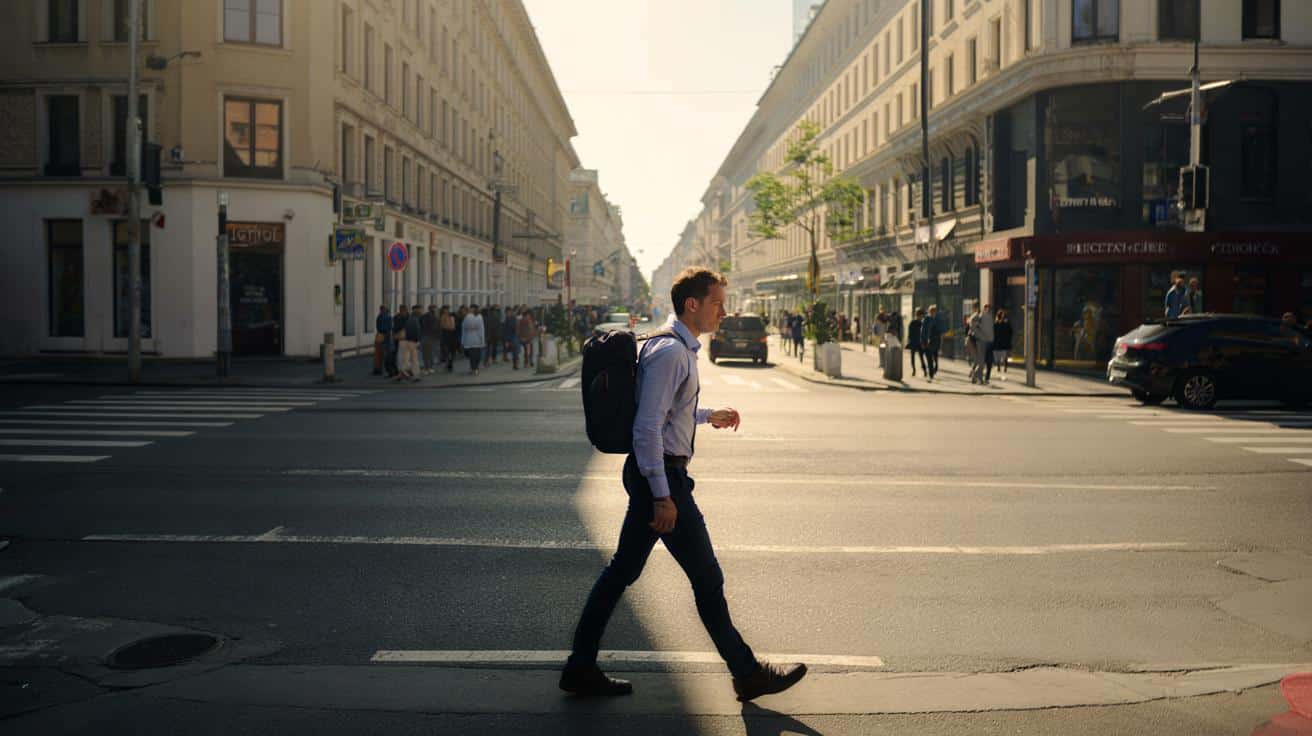
Every morning at 8:12, the same man passes my window with the same black backpack and the same slightly rushed step.
Rain, sun, tired Monday face or Friday glow, his route never seems to change.
Left at the corner bakery. Cross at the same light. Coffee in the same paper cup.
One day I caught myself waiting for him.
Wondering what would happen if the traffic light failed, or if the bakery closed, or if he suddenly turned right instead of left.
Psychologists say people like him, people who walk the same route daily, aren’t just creatures of habit.
They actually process uncertainty differently.
And that tiny detail – the sidewalk they choose, the corner they avoid – quietly reshapes the way their brain deals with the unknown.
What your daily walking route silently does to your mind
City psychologists who study everyday rituals have a phrase they like to use: “micro-routines of control.”
Your regular walking route is one of them.
Same streets, same shop fronts, same cracks in the pavement – it’s a moving bubble of predictability.
Inside that bubble, your brain relaxes a little.
The path is known, so your nervous system doesn’t have to scan for danger non-stop.
That doesn’t mean you’re on autopilot all the way, but your mind can shift energy from survival mode to something softer: thinking, daydreaming, planning.
Walk the same path long enough, and your body starts to know: here, at least, nothing unexpected is supposed to happen.
A research team in London followed commuters who walked to work every day for three months.
Half of them were people who swore by a fixed route.
The others wandered a bit: same destination, but different streets depending on the mood, the weather, the coffee urge.
The “fixed-route walkers” reported lower spikes of stress when their train was delayed or a meeting got moved last minute.
Their heart rate rose less in the face of sudden changes, as if their system could absorb a jolt more calmly.
Their brain, it seems, was used to having at least one piece of the day locked in.
The wandering group felt more stimulated, even a bit more creative, but also more sensitive to surprise.
When everything is potentially new, the unknown feels sharper on the skin.
Psychologists point to a simple mechanism.
The brain hates total chaos, but it also gets bored with total predictability.
So we build pockets of routine in the middle of a world we can’t fully control.
➡️ Psychologists reveal the three colors most common in people with low self-esteem
➡️ Workers in this field benefit from skills that companies struggle to replace
➡️ If you feel unsettled after positive news, psychology explains the anticipation response
➡️ Many households waste money by using appliances at the wrong time of day
➡️ Psychology explains why emotional restraint often develops quietly, without people even noticing it
Your daily route is one such pocket.
By anchoring part of your day in repetition, you reduce the general “noise” of uncertainty.
That frees up bandwidth to deal with bigger unknowns: a career change, a health scare, a tough conversation.
Walk the same way often enough and you train your system to say: “Some things are stable.
I can handle the rest.”
The way you handle traffic lights and corners slowly bleeds into the way you handle emails, conflicts, life decisions.
Using your route to train your brain for uncertainty
There’s a simple way psychologists suggest turning your walk into a mental lab.
Keep your core route the same, but add one small, controlled variation each week.
Take a different side of the street on Thursdays.
Stop at a new café once.
Walk the same road, but at a different pace, or with music off instead of on.
It’s a tiny experiment in safe unpredictability.
Your brain gets the comfort of the familiar map, and a gentle nudge that “change” doesn’t always mean “danger.”
Over time, that combination can soften the blow when real uncertainty hits.
The mistake many of us fall into is all-or-nothing.
Either we cling so tightly to our route that a blocked sidewalk ruins our whole mood.
Or we think we must be endlessly flexible, constantly changing, never repeating anything, in the name of growth.
Both extremes can backfire.
Rigid routine can make you fragile when the world refuses to cooperate.
Constant change can leave you exhausted, hyper-alert, and secretly craving a corner of stability.
We’ve all been there, that moment when a simple detour feels like a personal attack on your day.
Anxiety slips in and whispers: “If this small thing can go wrong, what else will?”
A gentler approach is to let your route be your base camp, not your prison.
Psychologist Laura Vail, who works with anxious city-dwellers, told me: “A familiar daily path is like a soft exhale for the nervous system.
But the people who cope best with uncertainty are the ones who sometimes let life mess with that path – on purpose.”
- Start with a “safe” routine
Pick a route you genuinely like, not just the shortest one.
Notice how your body feels when you walk it. Calm? Rushed? Numb? - Introduce one playful twist
- Use the walk to name your fears
On the familiar part of the route, mentally list what’s uncertain in your life right now.
On the “new” segment, ask yourself which of those fears is actually happening today. - Watch your inner commentary
- Let’s be honest: nobody really does this every single day.
You’ll forget, or be too tired, or just want the shortest way home.
That’s fine. The point isn’t perfection, it’s awareness.
Change one micro-detail: a new corner, a different crossing, pausing one minute on a bench.
Treat it like a game, not a test.
Notice if your first thought when something changes is “this is bad” or “this is interesting.”
That inner voice is exactly what your route work is training.
What your route says about you (and what you might want to change)
Walk the same path tomorrow and watch yourself as if you were a stranger.
Do you speed up at certain corners? Avoid eye contact at one crossing? Breathe easier when you hit a particular street?
Those tiny physical cues are like subtitles to how you meet uncertainty.
Some people unconsciously choose wide, open streets because closed alleys make them tense.
Others pick crowded routes because a quiet park feels oddly vulnerable.
*Your feet often know your fears before your mind has words for them.*
If you dare, tweak one of those patterns and see what happens.
Sometimes the real work with uncertainty starts with turning left where you usually turn right.
| Key point | Detail | Value for the reader |
|---|---|---|
| Daily routes create “pockets of control” | Repetition on the same streets lowers background stress and frees mental energy | Helps you feel less overwhelmed by bigger life uncertainties |
| Small, chosen changes train flexibility | Micro-variations on a familiar route teach the brain that change can be safe | Builds resilience for unexpected events and sudden disruptions |
| Your route reveals hidden patterns | Preferences for certain streets, crowds, or corners mirror how you handle the unknown | Gives you concrete clues to work on anxiety, avoidance, or over-control |
FAQ:
- Question 1Does walking the same route every day make me less adventurous?
- Answer 1Not automatically. A stable route can be a helpful anchor, as long as you occasionally invite small, chosen changes so you don’t become brittle when something shifts.
- Question 2What if I already feel anxious when I break my routine?
- Answer 2Start with tiny variations: crossing the street at a different point, changing your walking pace, or taking a one-minute pause. The idea is gentle exposure, not shock therapy.
- Question 3Is a changing route better for creativity?
- Answer 3New environments can spark ideas, but constant novelty can also drain you. Many creatives use a stable route, then let their mind wander wildly while their feet follow the same path.
- Question 4Can this really affect how I handle big life changes?
- Answer 4Psychologists say yes, because your nervous system doesn’t fully separate “small” and “big” uncertainty. Training on daily walks can subtly shift your overall tolerance for the unknown.
- Question 5What if I don’t walk much or work from home?
- Answer 5You can create a similar effect with any repeated path: the way you go to the supermarket, your loop around the block, even a staircase ritual at home with small variations.