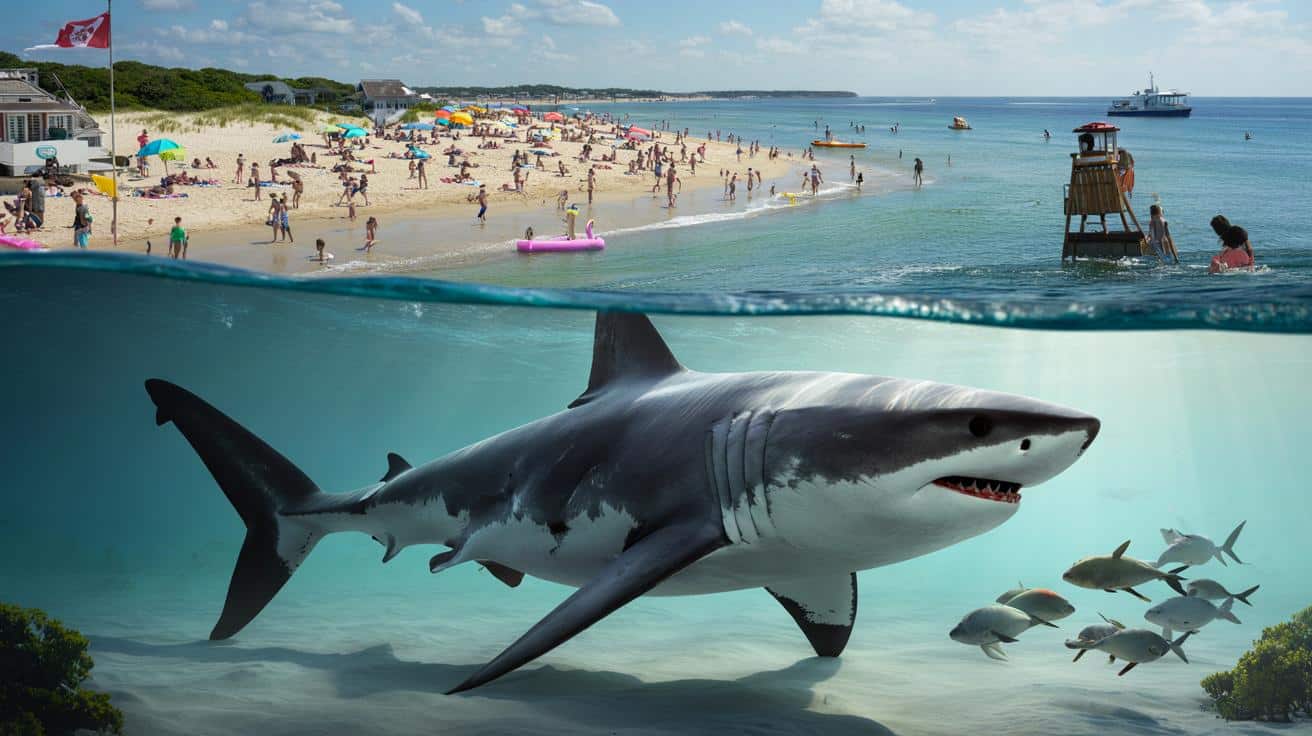
On a bright holiday morning off Cape Cod, the water looks almost fake. Flat as glass, streaked with paddleboards and inflatable flamingos, the ocean feels like a swimming pool someone forgot to clean the salt out of. Kids are shrieking in the shallows, adults are half-watching them while scrolling through their phones, and the lifeguard’s whistle cuts the air every few minutes, more out of habit than concern.
Out past the sandbars, something else is moving. Slowly. Purposefully.
A ping from a satellite tag flashes on a scientist’s screen miles away: a huge female great white shark, longer than an SUV, is gliding through one of the busiest tourist corridors on the East Coast.
Most people on the beach have no idea.
A record-size great white in vacation country
Somewhere between the cool green depths and the sunscreen haze at the surface, a 16-foot great white shark is cruising along a migration route that now overlaps with some of America’s favorite summer playgrounds. Scientists tracking her movements say she may be one of the largest individuals ever logged in the region, a powerful, aging female whose sheer bulk defies the “Jaws” stereotype of a mindless killer.
Closer to shore, charter boats are full, ferries are packed, and waterfront bars are already on their second round of frozen margaritas before noon. On land, the economy is humming. Offshore, the apex predator is doing what she’s done for decades: following food, temperature, and instinct.
A few weeks ago, researchers at a respected shark research group watched her signal pop up unexpectedly close to a cluster of beach towns. Her tag pinged near a sandbar known more for Instagram sunsets than for anything with teeth.
Locals were still unpacking coolers when a routine scan of the tracking map made one scientist sit up straighter. The shark—nicknamed by the team, as they tend to do—had ventured through a narrow corridor between two heavily touristed islands. That same day, lifeguards in the area quietly raised their red “hazard” flags, and town officials held a quick, tense meeting behind closed doors.
On social media, the story leaked in fragments: “giant white shark spotted near popular beach,” “record-size predator near swimmers.” The comments section did the rest.
From the scientists’ point of view, none of this is random. Warmer waters are drawing seals closer to shore in some regions, and where seals go, great whites follow. At the same time, conservation laws over the last few decades have started to pay off. Shark populations, once hammered by overfishing, are showing signs of recovery along certain coasts.
➡️ If you feel unsettled after positive news, psychology explains the anticipation response
➡️ Psychology explains why some people feel emotionally “braced” even when nothing bad is happening
➡️ In Finland they heat their homes without radiators, using an everyday object you already own
➡️ Psychologists note that people who walk the same route daily process uncertainty differently
So you get this collision: a growing number of very large sharks returning to habitats they dominated long before we drew property lines, at the exact moment coastal tourism is exploding. This isn’t a freak event. It’s what coexistence with a recovering ocean actually looks like.
What scientists quietly wish every beachgoer knew
When researchers say they “urge caution,” they’re not trying to cancel your vacation. They’re trying to slide a few simple habits into your beach day before muscle memory takes over. Step one starts before you even touch the water: look up.
Scan the lifeguard stand. Are there purple or red flags? Are there any shark advisory boards posted near the path? Many towns now rely on apps or text alerts when tagged sharks come close to shore, but they also depend on people actually reading those signs instead of blowing right past them with a surfboard and a speaker.
Then, ask the quiet question almost nobody does: “How’s the shark activity been this week?”
On the waterline, the difference between “pretty safe” and “not a great idea” can be a few simple details. Swimming at dawn or dusk, when visibility is low and prey is active, adds risk. Splashing far offshore, alone, adds more. Wearing shiny jewelry and thrashing around near a seal colony is basically playing the role of confused bait in a murky theater.
We’ve all been there, that moment when the sun is perfect, the water feels warm, and you forget that you’re not in charge out there. That’s the trap. You don’t need to be paranoid, just aware that you’re stepping into a wild food chain.
*The ocean doesn’t read the “family friendly beach” label on the travel brochure.*
Scientists say simple awareness beats high-tech fear every time. Swimming in groups, staying near lifeguards, and getting out of the water if a seal suddenly explodes out of the waves or a bait ball of fish tightens and darts—those are small decisions that stack the odds in your favor.
They’re also realistic. Let’s be honest: nobody really does this every single day.
As one marine biologist told me on a windy pier last summer:
“Great whites don’t want us. They want calorie-dense, predictable prey: seals, tuna, big fish. We become a problem when we behave like confused prey at the wrong place, at the wrong time.”
He rattled off the mental checklist he wishes people kept in mind:
- Check local advisories and flags before you swim.
- Avoid dawn, dusk, and murky water if sharks are known in the area.
- Stay out of seal hotspots and active fishing zones.
- Swim in groups, near lifeguards, not way beyond the crowd.
- Get out of the water calmly if wildlife suddenly goes wild.
Living with apex predators in vacation season
This record-size great white moving through a dense tourist corridor is less a horror story than a test. Can a modern beach culture that runs on selfies and speedboats slow down just enough to remember that the ocean is still wild?
Along many coasts, that conversation is already happening in small, messy ways: emergency meetings about drone surveillance, arguments over closing beaches, debates about whether to name sharks in public tracking apps or keep identities vague. Some locals feel oddly proud that such a massive predator calls their waters home. Others feel like a dark shadow has been cast over their summer economy.
Both reactions are real. Both sit side by side under the same beach umbrella.
| Key point | Detail | Value for the reader |
|---|---|---|
| Shark presence is rising | Conservation success and warmer waters are bringing more large great whites close to tourist coasts | Helps you understand why warnings are increasing without assuming panic or “media hype” |
| Simple habits reduce risk | Time of day, group swimming, avoiding seal areas, and reading flags/advisories matter | Gives you concrete ways to enjoy the ocean more safely with your family |
| Coexistence is the new normal | Tourism and apex predators now share the same space, especially in summer | Invites you to rethink your relationship with the sea, not just your weekend plans |
FAQ:
- Question 1Are great white shark attacks on swimmers actually common in tourist areas?
- Answer 1No. Encounters are still statistically rare, even in places where large great whites are present. Most tagged sharks move past busy beaches without anyone noticing. The risk exists, but it’s far lower than the fear suggests.
- Question 2Does a record-size shark mean beaches will be closed?
- Answer 2Not automatically. Local officials weigh tag data, lifeguard reports, and behavior patterns. Temporary closures or “no swimming” advisories usually happen when a shark lingers close to shore or is seen actively hunting near people.
- Question 3Is it safer to stay on the sand when sharks are migrating through?
- Answer 3Staying on shore eliminates shark risk, yes, but most people can still swim with reasonable caution. Avoid peak feeding times, don’t go far offshore, follow lifeguard guidance, and pay attention to wildlife behavior.
- Question 4Do shark deterrent devices really work?
- Answer 4Some electronic deterrents show promising results in controlled tests, especially for surfers and divers, but nothing is foolproof. Scientists generally see them as one more layer of risk reduction, not a magic shield.
- Question 5Why don’t authorities just remove or kill big sharks near tourist beaches?
- Answer 5Great whites are protected in many regions because their numbers plummeted in past decades. They play a crucial role in marine ecosystems. Most scientists argue that lethal control doesn’t reliably make beaches safer and can damage already stressed oceans.