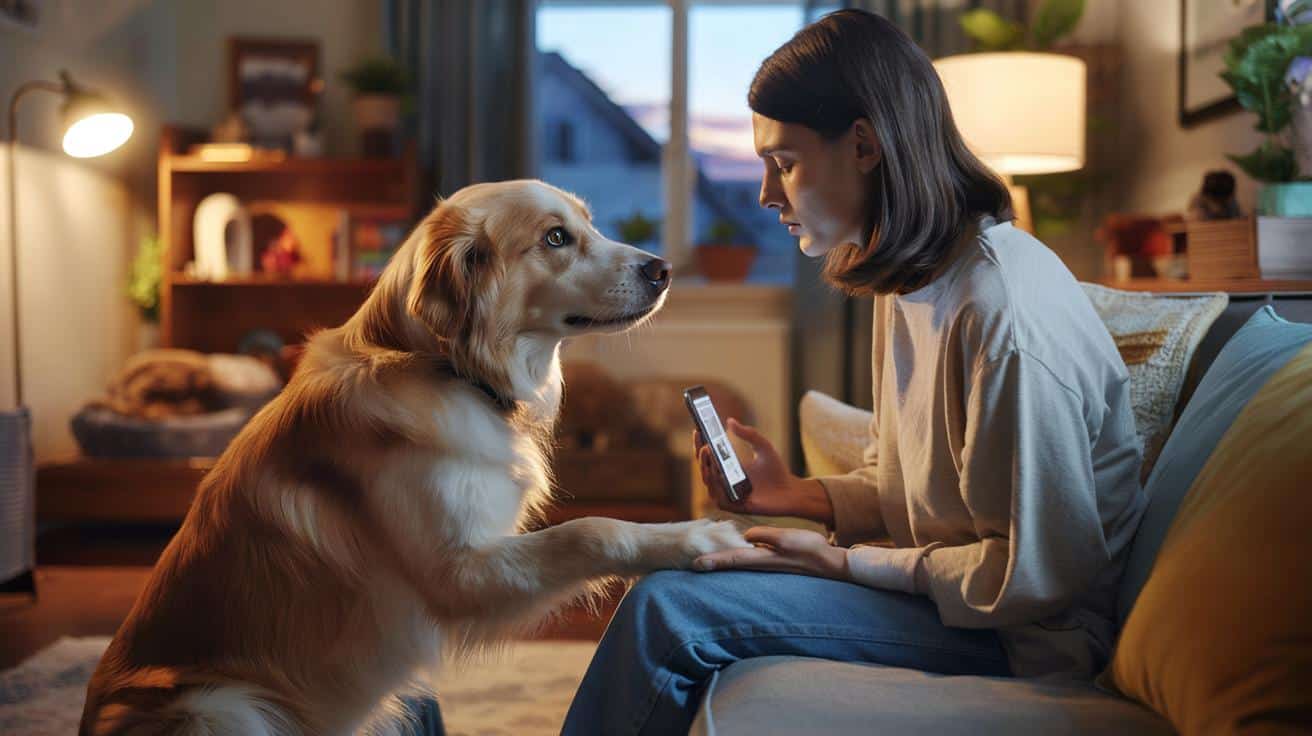
Your dog sits in front of you, tilts its head, and quietly raises a paw onto your knee. Not jumping. Not barking. Just that soft, insistent weight. You smile, say “Hi, you,” and absentmindedly pat his head. Two minutes later, the paw is back. Slightly firmer this time. You laugh, snap a photo for Instagram, and think, “He just wants to say hello.”
Then one evening, you’re distracted and don’t react. The paw comes again. Then again. The look in his eyes changes, almost worried. Suddenly it doesn’t feel like a joke anymore. It feels like he’s saying something you’re not quite hearing. Something a bit more serious.
When a paw on your leg is actually a message
Dog trainers repeat it all the time: a dog’s body speaks long before its mouth does. That famous paw on your leg is part of that language. Humans love to translate it as “shake,” “hello,” or “play with me,” but animal behaviorists see several other layers under this simple gesture. Sometimes it’s a polite request. Sometimes it’s a demand. And sometimes it’s a silent SOS.
Imagine that paws were your dog’s way to send text messages. One tap: “You there?” Two taps: “I need something.” Longer contact: “Stay with me, I’m not okay.” Once you start looking at it like that, those little paws suddenly gain a huge emotional weight. Behind this small, cute movement, there’s often a very real need trying to reach you.
A recent survey by a European veterinary association found that more than 60% of owners misinterpret at least one key signal of canine stress, pawing included. Many think their dog is simply being “clingy” or “annoying.” A behaviorist from Lyon shared with me the story of a Labrador who constantly offered his paw every evening around 7 p.m. His humans read it as a funny ritual. They filmed it, posted it, went viral. Weeks later, they discovered that 7 p.m. was also the time fireworks started in a nearby theme park, barely audible to them but a real thunderstorm of sound for the dog.
Each night, he wasn’t “playing.” He was asking for safety. Once the family began pairing that paw with a calm routine — closing shutters, soft music, a chew toy — the desperate pawing faded. Same gesture, radically different meaning once context and emotion were taken into account. This is where specialists insist: don’t look at the paw alone, look at the whole dog.
Ethologists explain that pawing is a “contact-seeking behavior,” the canine version of a child tugging at a sleeve. It’s a mix of instinct, learned habit, and emotional state. Your dog has noticed that paw + your leg = attention, sometimes food, sometimes comfort. So they repeat it. But under this conditioning lies something deeper: dogs are social animals wired to stay in connection with their “group.” When that link feels weak, uncertain, or threatened, they use what they have — eye contact, posture, and yes, paws — to repair it. What looks like a trick can be a genuine attempt to regulate distance and emotion between you.
Reading the paw: from “play with me” to “I’m not okay”
The first step is almost absurdly simple: pause. When your dog offers you a paw, resist the automatic “Oh, cute!” reflex for just two seconds and scan the scene. What is the tail doing? Is the body relaxed or tense? Ears forward, sideways, flattened? Breathing slow or fast? That micro-check already tells you if you’re looking at a playful request, a confident demand, or a worried plea.
Next, link the paw to what just happened. Were you scrolling for 30 minutes without looking at your dog once? Have there been loud noises? Has the routine changed, a guest arrived, a family member left? Dogs are contextual sponges. That same paw after a long walk in the park doesn’t mean the same thing as a paw in a silent apartment after a day of loneliness. *Context is the subtitle of every gesture your dog makes.*
Picture this: Emma, 32, works from home with her Border Collie, Nox. Every afternoon around 4 p.m., Nox starts to paw at her thigh while she’s at the computer. For months, Emma thought, “He’s so needy when I work.” She’d toss him a toy without really moving. The pawing got more intense. One day, she checked her smartwatch and realized something: 4 p.m. was also the moment she entered her longest screen tunnel, barely moving or speaking.
➡️ In Finland they heat their homes without radiators, using an everyday object you already own
➡️ Psychologists note that people who walk the same route daily process uncertainty differently
➡️ If you feel unsettled after positive news, psychology explains the anticipation response
➡️ Psychology: What Your Hands Behind Your Back Secretly Reveal About You
➡️ Psychologists reveal the three colors most common in people with low self-esteem
She decided to test a change. At the first paw, she stood up, stretched, grabbed the leash, and took Nox for a quick 10-minute sniff walk. After a week of this micro-ritual, the desperate pawing stopped. Nox still lifted his paw sometimes, but with a soft tail wag and relaxed eyes. His message had been: “Break time, please. I’m bored. You are too.” The behaviorist she consulted summed it up bluntly: what we call “needy” is often just a dog trying to co-regulate the household’s rhythm.
Now flip the script. A senior dog that never used to paw suddenly starts doing it at night, pacing, panting, resting a paw on your chest in bed. That’s not comedic. Vets report that changes in pawing patterns can sometimes signal pain, nausea, or cognitive decline. A Golden Retriever in one clinic began pawing at his owner’s stomach every evening, as if to prevent her from getting up. The story went viral because the woman later discovered an undiagnosed tumor. Not every paw is a miracle warning, of course. Still, behaviorists insist: when a quiet dog suddenly becomes very “handsy,” it’s worth a check-up.
The plain truth is: we often answer the paw without really listening to it. Tossing a treat, saying “Not now,” pushing the leg away. That’s like hanging up on a phone call without hearing who’s speaking. Animal specialists invite owners to become “micro-detectives,” tracking three clues each time: body language, timing, and repetition. When those three line up in an unusual way, the paw usually hides a precise request — for play, reassurance, contact, or sometimes medical help.
How to respond without reinforcing stress or frustration
Start by deciding what you want that paw to mean in your house. If you respond every single time with food, you’re teaching “Paw = snack dispenser.” If you respond with gentle attention and calm contact, you’re teaching “Paw = emotional check-in.” One simple method recommended by trainers: when your dog offers a paw, acknowledge it verbally first. A soft “I see you” or their name. Then choose between three responses: play, cuddle, or redirection.
If the dog looks relaxed and bouncy, turning the paw into a short play session or a mini training game works wonders. If the dog seems tense or worried, lean into calm contact: sit on the floor, offer your hand, slow your breathing. When you suspect boredom, redirect: “Okay, good boy, let’s go sniff,” and move to a different activity. Over time, your dog learns that the paw isn’t ignored but doesn’t always lead to the same outcome either, which reduces obsessive, frantic pawing.
Many owners feel guilty when they can’t respond. You’re on a work call, cooking, or simply drained. And yes, we’ve all been there, that moment when you whisper “Not now” to those big eyes and instantly feel like the worst person on earth. Animal specialists are clear: you’re allowed to have boundaries. What hurts dogs more is inconsistency. If you yell one day, laugh the next, then reward with treats the third, the dog escalates the gesture in pure confusion.
A softer path looks like this: calmly ignore the paw in the moment, then, when you’re free five or ten minutes later, actively seek your dog out. You restart the connection yourself: “Hey, now it’s our time.” That delayed but intentional attention reassures the dog that the bond isn’t broken, only postponed. Let’s be honest: nobody really does this every single day. Yet even trying a few times a week can shift your dog’s neediness into a calmer, more predictable rhythm.
As one Paris-based behaviorist told me:
“A dog that paws you is rarely ‘manipulative.’ It’s usually a dog that hasn’t learned any other polite way to say: I need you right now.”
To help both sides, specialists often suggest creating a tiny “toolbox” of responses at home:
- A 5-minute sniff-walk ritual when the paw appears at the same hour daily.
- A “calm corner” with a mat, where the dog is invited after a worried paw, paired with slow petting.
- A short brain game (snuffle mat, easy puzzle) for boredom paws.
- A vet check if a new, persistent pawing appears suddenly, especially at night.
- A hand signal that says “later,” followed by actual attention a bit afterward.
These small, clear answers turn the paw from a source of annoyance into a readable, almost tender form of communication. **You’re not just teaching tricks, you’re building a shared code.** And in that code, the famous “give paw” is less circus act and more emotional handshake between species. **Once you see it that way, you can’t really go back.**
A tiny gesture that quietly rewrites your bond
Next time a paw lands on your leg, try something different. Instead of reacting on autopilot, let that second stretch a little. Notice your dog’s eyes, the weight of the paw, the silence that sits between you. That small pause turns a routine moment into a kind of micro-conversation. It won’t be perfect. Some days you’ll miss the message, or answer too fast, or be too tired to care. That’s real life.
Yet dogs don’t ask for perfection. They ask for patterns that feel safe. When a paw regularly leads to some kind of recognition — a look, a word, a later cuddle — most dogs relax. Their gestures become less frantic, more subtle. They trust that the line between you isn’t cut, even when you’re busy or far away. For them, that paw is like a cable they plug into you, checking if the current is still passing. The more you answer, on your own human terms, the stronger that invisible wire grows.
Some owners say that once they truly listened to this gesture, they began to notice everything else: the small sighs, the micro-ear twitches, the way their dog sits a little closer on tough days. Suddenly, life with a dog stops being about commands and becomes about conversation. And all of it, strangely, starts with something as ordinary as a paw on your knee, on an evening when you almost didn’t look up from your phone.
| Key point | Detail | Value for the reader |
|---|---|---|
| Paw as communication | Dogs use their paw to seek contact, reassurance, or help, not just to play or greet | Helps owners recognize hidden emotional needs behind a common gesture |
| Context reading | Body language, timing, and repetition reveal whether the paw means play, stress, boredom, or pain | Gives a simple “3-clue” method to interpret pawing more accurately |
| Consistent responses | Clear, calm, and varied responses reduce frantic pawing and strengthen trust | Improves daily life with the dog and deepens the human–animal bond |
FAQ:
- Question 1My dog gives me his paw all day long. Is he just spoiled?
- Question 2How can I tell if pawing is a sign of pain or illness?
- Question 3Should I stop teaching the “shake hands” trick?
- Question 4What do I do if my dog scratches me with his paw to get attention?
- Question 5Is it okay to ignore my dog when he paws me while I’m working?