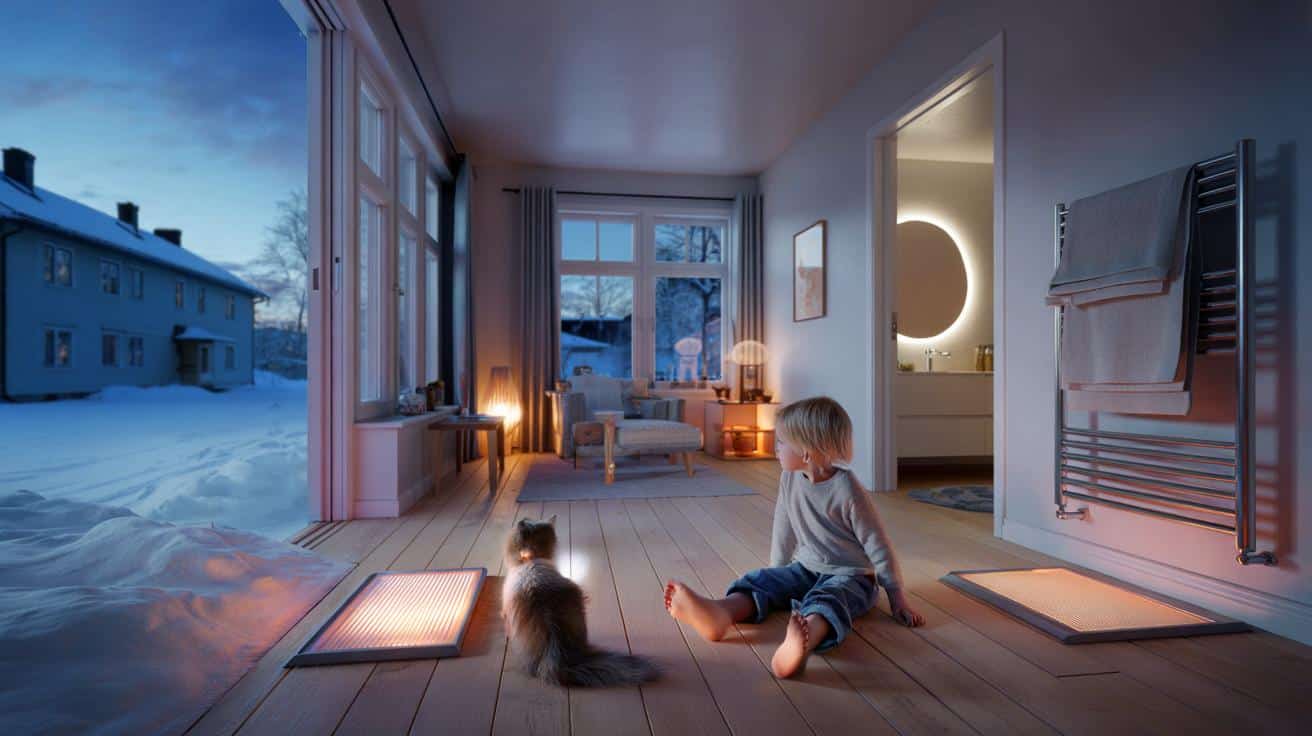
The first thing that hits you in a Finnish winter isn’t the snow, it’s the silence. Outside, the thermometer sulks somewhere around –15°C. Inside, socks on wooden floors, a kettle murmurs, kids drop backpacks with a dull thud. You wait for the metallic click of radiators waking up. Nothing. No cast-iron beasts under the windows. No hissing pipes. Just a soft, even warmth everywhere, like the house is wearing a wool sweater.
A Finnish friend laughs when you ask where the heaters are. He taps the floor with his heel, points to the bathroom mirror that never fogs up, waves his hand at the clean, uncluttered walls. The heat, it turns out, is hidden in plain sight, traveling through something you already know, already own, already touch every day. You just never thought of it as a heating system.
Because here, warmth doesn’t come from radiators. It comes from surfaces.
How Finns heat their homes without a single visible radiator
Walk into a typical Finnish apartment in January and your brain does a small double-take. The windows are big, the walls are bare, and there’s a lot of floor. No bulky convectors stealing space, no hot metal where kids can burn their hands. You stand there, waiting to feel a draft. Instead, your toes warm up. The comfort creeps in from below.
What’s happening is simple: the “radiator” is the floor itself. Under the parquet, tiles, or laminate, a network of hot-water pipes or electric cables turns the entire surface into a low-temperature heating panel. Heat rises gently and evenly, without that yo-yo effect you get with classic radiators. Your feet are warm, your head is cool, the air isn’t dry. It feels oddly natural, almost like sunlight.
Finns have pushed the idea further. Bathroom mirrors are heated so they never fog. Towel racks double as small radiators. Even the walls in some new builds hide large radiant panels. The principle stays the same: **use surfaces you already have** to quietly radiate heat, instead of installing big, visible devices. Once you’ve felt it, full-blast radiators feel clumsy and a bit… last century.
Part of this comes from necessity. When it’s freezing half the year, comfort matters, but so does efficiency. Traditional radiators heat air, which then escapes via leaks and drafts. Radiant systems heat objects, bodies, and the building itself. Floors store and release heat slowly, like a battery. Finland also relies heavily on district heating: hot water produced centrally and delivered to buildings, then circulated through these hidden surfaces. Less energy wasted, less dust flying around, more stable temperatures.
There’s a design bonus too. Get rid of radiators, and you free up walls. Furniture placement becomes easier, windows can run lower, the whole space looks calmer. The hidden heating matches that famously minimalist Nordic aesthetic. It’s not a gadget, it’s an invisible layer of comfort baked into the architecture. And yes, it changes how you think about that humble everyday object under your feet: the floor you walk on becomes the main heater in the house.
The everyday object that turns into a silent heater
So what’s this “everyday object” you already own that Finns use as a heater? Your floors. Every room has them, every home relies on them, but in many countries they’re just… there. Something to mop, something to scratch, something that gets cold in winter. In Finland, the floor becomes an active player. It’s wired or plumbed from the start to radiate a slow, steady warmth from the bottom up.
Here’s the twist: you don’t need a brand-new Nordic house to borrow the idea. Even in an older apartment, you can use your floors (and other surfaces) as stealth heaters. Thin electric underfloor mats under a rug in the living room. A heated film under bathroom tiles. A simple infrared panel fixed to the ceiling, radiating down like a small artificial sun. All of this uses what you already have — surfaces — instead of adding bulky boxes everywhere.
➡️ Workers in this field benefit from skills that companies struggle to replace
➡️ Psychologists reveal the three colors most common in people with low self-esteem
➡️ Psychology: What Your Hands Behind Your Back Secretly Reveal About You
➡️ “I became a shift coordinator, and bonuses significantly boosted my income”
➡️ 11 phrases that deeply selfish people often tend to say, unconsciously, in conversations
➡️ If you feel unsettled after positive news, psychology explains the anticipation response
One Helsinki family I visited had turned their tiny entryway into a secret heating hub. Beneath the dark tiles, electric cables ran like veins. Boots came in soaked with slush and were dry again by morning. The warmth spread discreetly into the adjoining rooms, taking the edge off the cold without any visible hardware. The dad told me they cut their radiator use in half after installing just that small floor zone. “The kids lie there like cats,” he joked.
There’s something deeply satisfying about this approach. You’re not fighting the cold with roaring fans and glowing coils. You’re turning calm, motionless surfaces into quiet allies. Floors, walls, mirrors, towel bars — they all become low-key heaters that don’t demand attention. It shifts the mindset from “add more devices” to “use what’s already there smarter”. *Heat doesn’t need to shout to work well.*
This kind of radiant heating also tends to feel warmer at lower air temperatures. When your feet are at 23°C and your body is surrounded by warm surfaces, you can set the thermostat lower and still feel comfortable. That’s where the energy savings sneak in. You trade short bursts of hot air from radiators for a continuous, gentle glow from the things you touch every day. The floor stops being an enemy in winter and becomes your favorite spot in the house.
How to copy the Finnish trick at home, step by step
If you rent and can’t rip up floors, start small. Target the places where you feel the cold most: the bathroom, under your desk, or the spot where everyone hangs out in the evening. A plug-in under-rug heating mat is one of the easiest hacks. You slide it under a carpet in the living room, plug it in, and your “cold floor” suddenly becomes a soft, warm island. Use it when you’re home, turn it off when you leave.
In the bathroom, a heated towel rail is the classic Finnish-style move. It dries towels, gently warms the room, and feels like a little everyday luxury. If you own your place and want to go further, ask about thin electric underfloor heating when you next redo the tiles. The cables or mats add only a few millimeters of height, and you’re turning an existing surface into a permanent heater. No extra space needed, no whirring fans.
Now comes the honest part: people often buy these things and barely use them. Let’s be honest: nobody really does this every single day. The mat stays rolled in a closet, the timer on the towel rail never gets programmed, the thermostat is left on the default setting. That’s a shame, because the magic of radiant systems is in their regular, low-key use, not in emergency “I’m freezing” moments.
A simple habit shift helps. Instead of cranking up radiators to 23°C for two hours, keep them slightly lower and turn on your “smart surfaces” in the zones where you actually spend time. You’re not heating corridors or empty corners, you’re heating the floor under your feet while you read, work, or cook. That targeted comfort is exactly how the Finns think about warmth: focused, not wasteful.
One Finnish architect summed it up during our conversation in his kitchen, feet on a warm tiled floor:
“There’s no point heating the whole volume of air if you can warm the places where your body really feels it — feet, hands, back.”
He recommended a few simple steps to start “radiant thinking” at home:
- Drop your general thermostat by 1°C and compensate with a warm floor zone where you sit most
- Use programmable timers on towel warmers or floor mats to run them only when you’re home
- Prioritize surfaces you touch: bathroom floors, entryways, under-desk areas, kids’ play corners
- Avoid covering heated floors with thick, insulating rugs that block the radiant effect
- For bigger renovations, ask specifically about low-temperature radiant systems instead of more radiators
Rethinking what “warm” means at home
The more time you spend in Finnish homes, the more you realize they’re not obsessed with high temperatures. They’re obsessed with smart comfort. Warm socks, thick curtains, a hot drink, a floor that doesn’t freeze your toes at 7 a.m. They add layers of quiet solutions instead of one brutal blast from a radiator under every window. That mindset is strangely freeing once you’ve felt it.
It also pushes you to look at your own home differently. The hallway you always rush through could become a drying zone with a small warm floor patch. The bathroom where you shiver after a shower could be transformed with a heated mirror and rail. Even your current radiators can be run at a gentler, lower temperature if you support them with these “smart surfaces”. You’re no longer fighting against your house, you’re collaborating with it.
We’ve all been there, that moment when you stand in the middle of your living room in winter and think, “I pay a lot for heating, and I’m still cold.” The Finnish way doesn’t magically fix every bill, but it changes the equation. Instead of buying more and bigger heaters, you enlist the floors, walls, and objects you already own. You turn the background of your life — the surfaces you barely notice — into an invisible comfort system.
Maybe that’s the quiet lesson from those silent, snow-wrapped Finnish neighborhoods. Warmth isn’t a metal box humming under the window. It’s the way your home holds you, from the soles of your feet to the tip of your nose. Once you’ve felt heat coming from the very floorboards, you start to wonder: which everyday object in your own place is waiting to become your next hidden heater?
| Key point | Detail | Value for the reader |
|---|---|---|
| Use existing surfaces as heaters | Floors, walls, mirrors, and towel rails can become low-temperature radiant panels | Gain comfort without adding bulky radiators or clutter |
| Targeted warmth beats overheating | Warm the zones where you actually stand, sit, and walk instead of all the air | Reduce bills while feeling warmer in daily life |
| Start small, scale later | Plug-in floor mats, towel warmers, and thin underfloor systems during renovations | Accessible path from a simple hack to a more Finnish-style heating setup |
FAQ:
- Is underfloor heating expensive to run?Low-temperature systems spread heat over a large surface, so many users can lower the overall thermostat and keep costs under control, especially if used in targeted zones.
- Can I install heated floors in an old apartment?Yes, thin electric mats or films are designed for renovations and can often be laid over existing floors with minimal extra height, depending on local rules and wiring.
- Do radiant floors replace radiators completely?In many Finnish homes they do, but in older or poorly insulated buildings, they can also work as a complementary system that lets you turn radiators down.
- Are heated floors safe for children and pets?They run at relatively low temperatures, so pets love them and kids can sit or crawl on them without risk of burns, unlike very hot radiators.
- Which room is best to start with?Bathrooms and entryways are ideal: cold tiles become comfortable, and wet towels or shoes dry faster, giving an immediate, very tangible benefit.